
Blog
- Home

- Blog
19 June 2025
You Clicked ‘Agree’ — But Did You Really Consent?
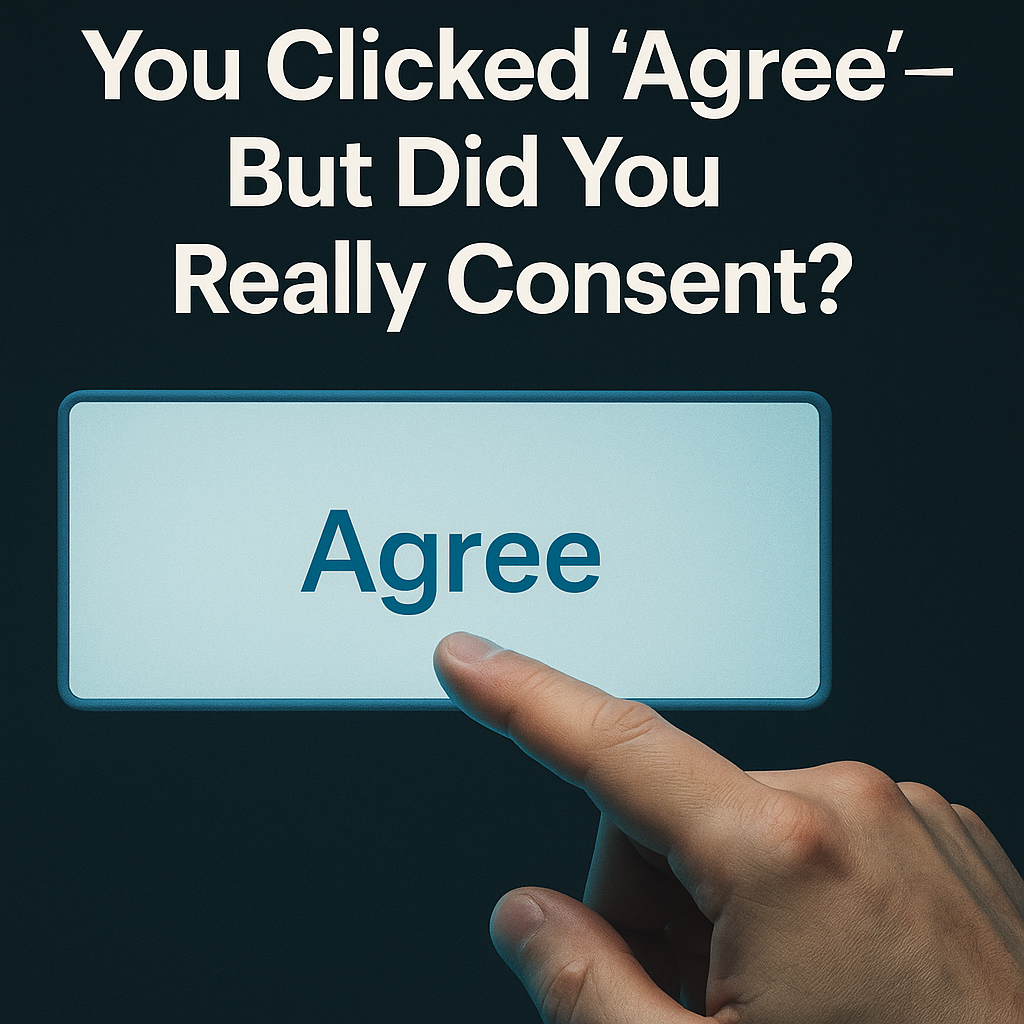
It’s 2AM. You’re half-asleep, eyes glazed over, when the app hits you with a 50-page privacy policy.
You click “Agree” faster than your brain can process the first sentence — not because you read it, but because you want access.
Welcome to the illusion of consent.
The Great Digital Deception
Let’s call it what it is: today’s digital consent is a formality masquerading as freedom.
It gives users a sense of control, but the reality is far more sinister.
Behind every checkbox lies a power transfer — one where liability shifts from the platform to you, the user. And all it took was one tired, desperate click.
We have reached a point where “I Agree” doesn’t mean “I understand” — it simply means: “I don’t have a choice.”
Consent Is Broken By Design
We’ve been conditioned to believe that consent equals protection. That ticking a box means we’ve been “empowered.” But here’s the truth:
- Privacy policies are written in legal Latin, not human language.
- Platforms rarely give you a real alternative.
- Most users click “Agree” out of exhaustion, not understanding.
- And worse — some data isn’t even collected with your consent. It’s inferred, purchased, or scraped.
This is not user empowerment.
This is systemic abdication of responsibility— dressed up in UX.
The Illusion of Choice
Picture this: you’re updating your phone. You’re presented with 70 screens of legalese. There’s only one option — click “Agree” or your device becomes unusable.
That’s not consent. That’s coercion with a smiley face.
In theory, we “chose” this.
In practice, it’s digital extortion.
And regulators allow it — because the checkbox exists.
Time for a New Framework: From Consent to Custodianship
If we want to fix the broken system, we must rebuild the foundation. That means:
1. Stewardship Over Checkbox Compliance
If a company collects, stores, or uses personal data — they should be liable for its misuse. Period.
You don’t get to shift blame just because a user clicked “Agree.”
2. Define Acceptable Use, Not Just Ask for Permission
Fraud detection? Necessary. Research with proper safeguards? Sensible.
Stalking, profiling, and predictive manipulation? Absolutely not.
We need rules — not just rituals.
3. Redress Must Be Built-In
When (not if) data leaks happen, users deserve transparency, compensation, and action — not silence or vague PR statements.
4. Make Consent Real Again
If you must ask for consent, make it timely, meaningful, and interruptive only when it matters — not 50 pop-ups deep into legal hell.
Raven’s Digital Privacy Ethos
At Raven, we don’t believe in tick-box privacy.
We believe in dignity-by-design — a philosophy where trust is built into the system, not dumped onto the user.
We believe companies should act as data custodians, not extractive miners.
Because privacy isn’t a “feature” — it’s a human right.
The future of digital governance won’t be built on paper trails of pretend permissions.
It’ll be built on accountability, ethics, and trust engineered into every interaction.
⚠️ TL;DR
✅ You clicked “Agree”
❌ But that wasn’t real consent
🧠 It’s time for a new model: Consent ≠ Protection. Custodianship = Accountability.
Ready to rethink your data governance model?
Let’s talk. Raven’s here to lead the paradigm shift.


